An Interview with Numismatic Artist Beth Zaiken
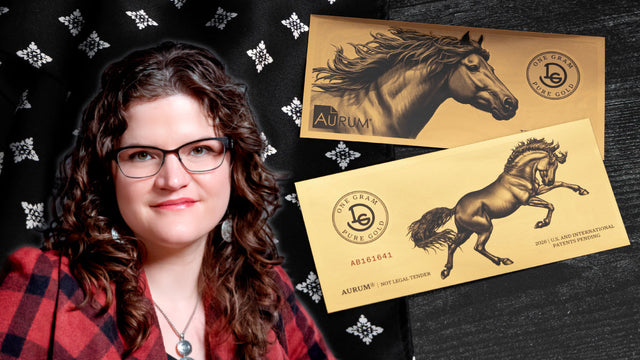
Discussing Beth Zaiken’s Artwork Featured on the Mustang Gram Aurum®
With her intricate designs and clear passion for the subject matter, artist Beth Zaiken is well known among numismatists. Her skills and interests have led her to numerous high-profile projects for the United States Mint, including multiple commemorative coin and medal designs. She’s also an award-winning illustrator who has completed projects for the Smithsonian, San Diego Zoo, and the New York State Museum, among others. In addition, Zaiken’s illustrations have been featured in world renowned publications, including Nature and the Scientific American.
Most of Zaiken’s illustrations showcase her lifelong fascination with the animal kingdom, from tiny invertebrates to large mammals to the extinct creatures that once roamed the earth. Her passion comes through in each brush stroke, and all of her projects demonstrate an ingrained love of the natural world. For these reasons, Zaiken was an obvious choice to illustrate the latest Aurum bill – the Mustang Gram. We reached out to her in the early days of developing this series, and we were overjoyed to receive an enthusiastic “yes” when we asked her to participate.
We recently sat down with Beth to learn more about her background, her creative process, and what attracted her to the Mustang Gram project. Highlights from this interview are featured below.
Valaurum (V): Hi Beth. Let’s start off by discussing the excitement surrounding the Mustang Gram release. A lot of that excitement comes from the fact that we’re working with you on this project. You’re very well known among numismatists.
Beth Zaiken (BZ): I’m starting to be! Coin design has been a sort of unexpected and delightful side quest that I'm on because [coin design] was never something I saw myself becoming involved with in any way – I just sort of fell into it.
V: That’s an interesting way to land in this field. Can you expand on that?
BZ: Well, my background is primarily as a museum fabrication artist, so I do natural history painting and sculpting. Most of my career has involved working with museums. I’ve been making dioramas, sculpting animals, and painting background murals. I happened to see the U.S. Mint put out a call for artists, and I thought, “oh, I meet all of these requirements. This could be fun.” I applied and made it all the way in [to the AIP program]. It’s been kind of a whirlwind. So I've been doing a lot of that work in the last few years, too. I’ve had a lot of fun tangents in my career, but it turns out it’s all related to educating and communicating through the artwork!
V: Would you say it’s the confluence of all those things coming together, plus your newfound interest in coin development, that informs what you’re doing with the Mustang Gram?
BZ: Well first I loved that you chose the Kiger Mustang because it’s local to Oregon. There are mustangs all over the United States, but Oregon’s Kiger Mustang is a particularly famous breed, so it was nice to feature them specifically.
I spent a lot of time in my career thinking about “deep time,” which refers to the world on a geological time scale. I often work with [drawings of] animals that have been extinct or look like nothing we have in the modern era.
I’ve done a lot of projects that are based in the Pleistocene, which is the ‘Ice Age’ in North America. If you look at horses from that perspective, from that deep time perspective, horses evolved here in North America. So I think of them as like a native animal because they have always belonged here. They grew up, you know, they evolved and adapted to this continent, and they only just disappeared from the continent approximately 10,000 years ago, which in deep time is like nothing. There were humans here already at that time.
All horses evolved here in North America, disappeared from this continent but migrated to Eurasia, where they were domesticated. Then they ended up back in North America, exactly where they evolved, in the form of the Spanish Mustangs that were brought here. I think of them as sort of immigrants, but they're also native. They are a quintessentially symbolic American animal because they echo the way many of us got here. And then they went on to become this melting pot of different breeds from all over the world, just like us. Feral horses often become the most fit animal for the environment that they live in, and they live all over the country. You find horses in the desert; you find them in the mountains. They live through some of the most challenging environments, and it’s made them just tough and scrappy – just like the American people. I love to feature them as a sort of symbol or metaphor for all of us for that reason.
V: Can you talk more about your creative process?
BZ: My artistic background and experience has informed my ability to draw animals, and animal anatomy is essentially universal across all different structures and time periods. Horses are particularly great because they’re your basic quadruped, but you can give them such a personality. There is something about horses that just speaks to us on a fundamental level, because they’re so intrinsically linked to the societies we’ve built over millennia. I wanted to emphasize the wildness and strength for this Kiger Mustang, to fully showcase its character. That’s why its mane is flying and its legs are bucking in my depiction. I wanted to show the motion. Horses are such dynamic animals. They’re the ballet dancers of the animal world.
V: Are you saying horses have a deeper societal connection because they helped build this modern society?
BZ: Exactly. They helped build our human world and they have played a very important role historically within our greater societal structure. For example, trains are built to fit the railroad tracks, but the width of the tracks corresponds to the width of an average road. Road design goes all the way back to the scale of Roman chariots, and a Roman chariot is sized to fit two horses side by side. Historically, the horse has shaped the way we’ve built our entire industrial environment. I think we should have a greater appreciation for horses, for all the things they’ve done for us, and for all the reasons they’re a symbol and a partner in the human experience.
V: That passion is so evident in your work. It really adds extra dimension to your art. Speaking of artwork, can we discuss some of the coins you’ve created for the U.S. Mint?
BZ: I really enjoy my work with the U.S. Mint. There are high standards and lots of stakeholders, which has been a very natural transition for me. I get to work on projects that are meaningful and important, that are legacy pieces for us as a people. I worked on the Harriet Tubman Silver Dollar, which was an incredible project. More recently, I designed the Patsy Takemoto Mink quarter for the American Women Quarters series. She was instrumental in getting the Title IX legislation passed, and I’m definitely a beneficiary of that legislation. It was an honor to work on her coin. The historical aspect of coin design really holds my interest because it’s always commemorating something great and important. I worked on the Rosie the Riveter Congressional Gold Medal, (which has such a cool design) and I was able to attend the inaugural award ceremony in the Capitol building. My work with the U.S. Mint has made me feel like I’m contributing something to my country; there’s no greater gift in the world than doing something you love at the highest possible level. Every project I’ve worked on has felt so much bigger than me. I love that.
V: Going back to the Mustang Gram project, what’s something that has resonated with you that you’d like to highlight?
BZ: Working on the Mustang Gram has been a really fun change for me. You’re using my 2D artwork as I’ve drawn it, and it’s on this larger horizontal frame, rather than a small coin. Typically, my numismatic drawings go through a sculptural process to produce the 3D elements, so additional artists will contribute before the final product is minted. With the Mustang Gram, I get to see my drawing in print, as intended, which will be very cool. I work on 2D projects all the time, but this is my first project that combines 2D art with a numismatic product. I love that the Mustang Gram emphasizes both the beauty of the drawing and the beauty of the gold. It’s very modern and clean. I’m excited to see it come together. I think it’s really going to resonate with people.
V: Thanks so much, Beth, for taking the time to talk with us, and for sharing your immense talents with Valaurum.